Featured

The Mixed Truth of Discrimination.

Written By Asia Sahota, International Business Student. Reading time – 2:30 minutes
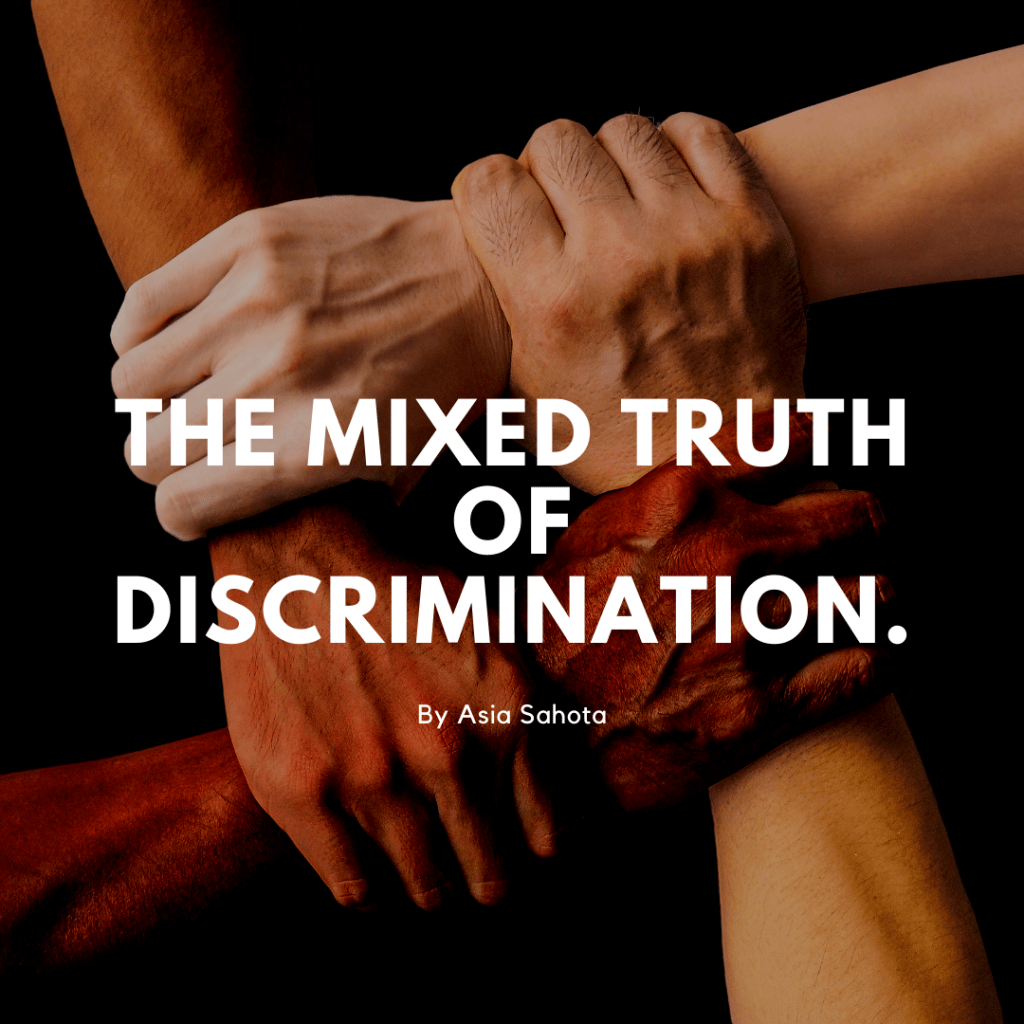
Image by truthseeker08 from Pixabay 

Racism and discrimination against mixed ethnic people is a problem which is not as widely shouted about in the fight for equality; however, it proposes a growing issue for the workforce, since its predicted that by 2050, 30% of UK population will be from mixed ethnic minorities.

The academic discourse behind discrimination has mainly focused on ethnic minorities of specific groups, however I feel that there is a huge lack of focus on minorities who come from a mixed background, like me. 

Often, I feel like those of mixed background are often discriminated from groups for not 100% belonging to a specific race. For myself I either wasn’t Western enough to be Western or I wasn’t Eastern enough to be Eastern, and for me this discrimination made me feel misunderstood which lead to me feeling a need to prove myself to others and ultimately left me feeling unworthy in a battle with mental health issues.

Right now, I feel were seeing the major struggle of being mixed-race and the unspoken racism experienced from both sides.

“I wasn’t Western enough to be Western or I wasn’t Eastern enough to be Eastern”

With the international barriers being lifted in business and the recent, at times forceful, push to be ‘diverse’ within companies increasing, I feel that mixed raced people are almost romanticised and selected for employment purely based on ethnic appearance to look good on paper, but when dealt with by management and colleagues, we’re subjected to unconscious bias or deliberately hated on for being employed by management, because companies have to fulfil this diversity quota. (Take a look at Google‘s diversity issue.) This is not something that makes us feel truly valued, if anything we feel used and singled out.

In a paper by Synergi, there is evidence to suggest that racism has directly been linked to the rise of ethnic inequality in the mental health system, and the increasing emergence of mental illnesses. 

In 2017 the UK saw an overall cost to employers for mental health £34.9 billion! (£10.6 billion lost in sickness absence, £21.2 billion lost to reduced productivity at work, or ‘presenteeism’ and £3.1 billion spent on replacing staff who leave their jobs because of their mental health.)

With this being said, I feel that I’m well within my right to say that those of mixed-race background may find it harder to be taken seriously and harder to justify or explain the mental health issues caused by discrimination. I feel this forces mixed races to work harder in the pursuit of proving their worthiness to be accepted into communities within and outside the workplace.

The ripples felt by racism are much larger than most would think; it creates stagnation in progression, a rise in mental health issues, economic slowdown and huge opportunity costs for companies to harbour the true benefits of having a well accepted – diverse workforce. If we don’t address this unconscious discrimination now then we can’t address the humongous costs created by discrimination and the resulting mental health issues in business.

To even those money hungry CEO’s, I hope this argument may give them another reason to make the relevant changes to be more responsible and understanding of the breadth of issues discrimination creates which are faced by all minorities – not just the obvious victims.
The Businesses Behaving Badly Amid CoVid-19

Written By Asia Sahota, International Business Student. Reading time – 2:30 minutes
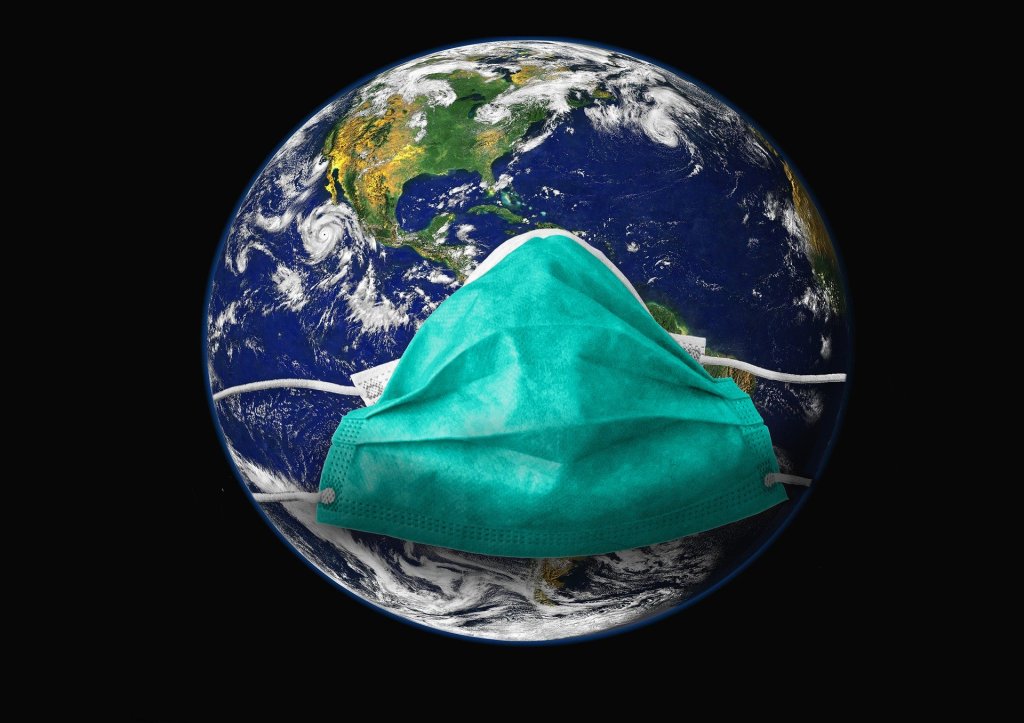
Image by Alexandra_Koch from Pixabay

Its January 2020, business is ticking over nicely, with global growth, (estimated at 2.9 percent in 2019), projected to increase to 3.3 percent in 2020 by the IMF. Company attitudes have shifted towards ‘value’ and ‘corporate social responsibility’; and companies are increasingly crafting their strategies around their employees.

Corporate responsibility is making its way to the boardroom, and the ‘bottom-line’  is no longer the key objective in influencing key business decisions.

Consideration of social impact is no longer optional when forming business strategies, and with employees and investors expecting more, companies are cultivating corporate cultures through a sense of ‘belonging’.

Fast forward to today, May 2020, and the picture is the very opposite.

Global trade has fallen at the fastest rate since the financial crisis of 2008, and with the terrifying pandemic threatening the worlds health and economy, business certainly isn’t as usual.

Lockdown measures imposed across the world have disrupted production and supply chains across automotive, travel & tourism, healthcare, high-tech manufacturing, and retail industries; and with non-essential business grinding to a halt, companies are faced with the tough decisions of how to weather the storm.

It’s clear to see that the focus on ethical business practise has been forgotten…

Unfortunately its clear to see that the focus on ethical business practise has been forgotten, with thousands of worker layoffs, an unwillingness to pay workers affected by the pandemic and even stories emerging  that employees are being forced to work non-essentially, in conditions which don’t comply with social distancing rules (despite government furlough schemes); ASOS, Amazon, EasyJet, Virgin Atlantic and Wetherspoon’s are among the list of companies behaving badly..

The economic impact has meant companies are at risk or have already suffered huge profit losses, even to the extent of bankruptcy; as seen by Hertz the car rental company, which has filed for bankruptcy after pandemic losses. The pandemic has created an economic crisis and company decisions are hitting those most vulnerable, with a huge rise in disproportional global unemployment and a huge psychological impact, affecting millions of people and the workforce around the world.

The pandemic has highlighted the impacts of company decisions on society, and with shareholders and the ‘bottom line’ once again being prioritised over the social needs of the workforce, will these companies be forgiven, or will the companies who made selfish decisions to survive the pandemic be punished by society when life goes back to normal?

About Me: Asia Sahota

My name is Asia Sahota, I’m 19 years old and currently studying in my first year of university on an international business management course.

Im interested in business management related topics and I hope I can shed my own insight into hot topics which are revenant to our society today.

A little about me:

I have obtained my A-Levels at Peter Symmonds College in: Italian, Economics, Photography and Psychology.

My passion for the arts is persistent in my dedication to learning the Cello and Guitar.

I worked and volunteered as a Police Cadet and Officer in my college years and GAP year, where I worked up to become the very first police ambassador and escort to the Queens representative of Hampshire, the Lord Lieutenant. It was a fantastic experience and allowed me to learn more about life from different perspectives and taught me fantastic life skills which I feel I’m rare and lucky to have obtained.

In the future I would love to be able to make a change for women in business, taking particular interest in this change due to the fact my mother was a business woman and has had to jump through astonishing hurdles to get to where she is today; she is my greatest role model and for that I want to be able to make her proud and make the future for women in business an exciting new prospect for my future children.

If you enjoy what I write, please subscribe and comment; I’d love to hear your opinions and create our own talking points so that we can learn and bounce of each others perspectives.

Wish me luck, and happy reading!

Asia Sahota x

Design a site like this with WordPress.com
Get started